
Prime Minister Dr Manmohan Singh on Saturday said that a needless controversy had been created over the Pokhran II nuclear tests that took place in May 1998.
Dismissing a top nuclear scientist's contention that Pokharan II was not a complete success, Atomic Energy Commission chief Anil Kakodkar on Friday said the tests in 1998 achieved '100 per cent desired results'.Speaking at a function organised by the Raja Ramanna Centre for Advanced Technology in Indore, Kakodkar said, "Pokhran II tests were a complete success and they achieved 100 per cent desired results."

Former Defence Research and Development Organisation scientist K Santhanam, who had questioned the success of the thermonuclear device during the Pokhran-II tests, has favoured an inquiry to determine the results of the 1998 experiments, saying creation of nuclear power could not be based on myths.

"They (Armed Forces) need to be reassured about the weapon system they use and about the planning of what kind of the yield they have when they hit the target," Malik, the army chief during Pokhran-II, told Karan Thapar on the Devil's Advocate programme of CNN-IBN.

A US nonprofit policy think tank, the Federation of American Scientists (FAS), estimates India's nuclear arsenal at 190 warheads, including those for new missiles under production. The report highlights India's ongoing modernisation of its nuclear capabilities and adherence to a no-first-use doctrine, while also noting uncertainties in warhead designs and plutonium reserves.
The failure of India's sole H-bomb is the latest in the Department of Atomic Energy and Bhabha Atomic Research Centre's long history of being economical with the truth.
Although the United Progressive Alliance government, in an undeclared policy, has decided to not celebrate the scientific achievement but few functions have been arranged unofficially to mark the day -- remembered as Pokhran-II.
The United States' nonproliferation lobby is apparently relishing the controversy ignited by erstwhile Defense and Research Development Organization scientist K Santhanam that the May 1998 Pokhran thermonuclear tests were not a full success implying that India needs to test again.
Chidambaram, who led the team of scientists during the 1998 nuclear tests, today dismissed as "absurd" suggestions that Pokhran-II explosions did not yield the desired results.
Former President A P J Abdul Kalam said the Pokhran tests of 1998 were successful as desired yield was obtained. Kalam was reacting to former senior Defence Research and Development Organisation scientist K Santhanam's contention that Pokhran-II tests had not met the desired objective.
India is strengthening the naval component of its nuclear triad with Navy Chief Admiral Dinesh K Tripathi on Tuesday saying that the third indigenous nuclear-powered submarine 'Aridaman' will be commissioned soon and that his force is focusing on boosting its overall combat prowess.
Senior DRDO scientist K Santhanam on Thursday reiterated that there was no question about backing away from his assertion that the 1998 Pokhran II nuclear tests were not fully successful, while the Chief of Naval Staff, Admiral Sureesh Mehta, said the tests conducted eleven years ago were adequate.
To say now that the test was a fizzle and that he knew it all along has caused a lot of concern in the minds of our public. This could unwittingly encourage adventurism by India's adversaries.
Without the lifting of the technology denial and India acquiring the ability to interact freely with all major nations economically and technologically India will not be able to have a real independent foreign policy which will make it an effective balancer of power. That was the real purpose of Pokhran II.
'There is a change in the administration in the United States of America. They are bound to further pressurise India to sign the CTBT. In such an event it was necessary to make such a statement or speak the truth on the issue so that India does not rush into signing the CTBT.'

'We were in a heavily nuclearised environment. China had tested for Pakistan in the 1980s and helped their missile programme stay just one step behind us.'

It's time India re-visited its Western alliances for the attitude and approach that the West reserves for the nation when it comes to security cooperation of the kind that they might not have visualised outside of China, India's bug-bear, asserts N Sathiya Moorthy.
Dr A N Prasad, former director of the Bhabha Atomic Research Centre and a distinguished nuclear scientist, explains the reasons behind Santhanam's statement on Pokhran II and its possible implications for India.
India does not need to carry any more nuclear tests, Atomic Energy commission chief Anil Kakodkar said on Wednesday in the backdrop of the controversy over whether the 1998 Pokhran thermo-nuclear explosion was a fizzle.
Ten years after India's nuclear tests, C Uday Bhaskar reckons the country was well served by revealing its capabilities.

Nuclear tests of 1998 have given us capability to build deterrence both in fission and fusion categories, Anil Kakodkar, Chairman, Atomic Energy Commission, said on Thursday.

The defence ministry on Thursday rejected senior Defence Research and Development Organisation scientist K Santhanam's assertion that the 1998 Pokhran II nuclear tests were not fully successful, adding that India has a meaningful number of nuclear weapons and an effective delivery system to go with it.

The reality is that far from being friendless, India is better positioned in the world than at any point post-Cold War, asserts Shekhar Gupta.
Retired Commodore Uday Bhaskar, leading strategic analyst, has predicted that the Indo-US relationship 10 years into the future will still remain on track even if the bilateral civilian nuclear deal is not consummated because it is now driven largely by non-government actors.
Three years before Pokhran II nuclear tests in 1998, India was interested in negotiations with Pakistan on elimination of atomic weapons from the subcontinent and was receptive to United States' mediation in this regard, an influential American Senator claimed on Friday.

Santhanam recently stirred a controversy claiming that the nuclear tests done in 1998 were not successful as projected at that time.

The development and trials will continue and the rocket is expected to enter service any time now.
The major upgrades would be missile-firing capability against long-range targets, panoramic sight with night vision to engage targets effectively at night, containerisation of the ammunition, enhanced main weapon penetration; additional ammunition types, explosive reactive armour, an advanced air-defence gun to engage helicopters.
What was the experience of meeting Vajpayee like?

As an aerospace scientist, Kalam worked with India's two major space research organisations --DRDO and ISRO.

Parliament on Tuesday hailed A P J Abdul Kalam as the "real gem" of India, saying the death of the former President has taken away its "true son" who became the driving force behind the country's space and missile programme.
There is no use of the BJP targeting the likes of Mamata Banerjee and M K Stalin, directly by the party's political bosses, both in Delhi and the respective state capitals, or even using the Raj Bhavans to fire those salvos from. Successive elections have proved that it's counter-productive, if anything. But the BJP is yet to understand it, acknowledge it, points out N Sathiya Moorthy.

During Vajpayee's tenure, he was there as an indispensable insider, witness to every action that had an impact on history: Pokhran-II (nuclear tests in 1998), the 1999 Kargil conflict between India and Pakistan, the Indo-Pak Agra Summit in 2001, intense engagement with the United States on nuclear issues besides the Kandahar hijack.

Fernandes sent defence ministry officials on familiarisation trips to various parts of Jammu and Kashmir and to the areas bordering China in Arunachal to see for themselves the difficulties faced by border guards.

Vajpayee had always felt that India must act with conviction and panache. He decided that, irrespective of the attendant risks, he would undertake what many felt was a precarious course. A fascinating excerpt from N K Singh's Portraits Of Power: Half A Century Of Being At Ringside on Atalji's 96th birthday, December 25.

It is time the political leaderships in this country arrived at a common ground over issues of foreign and security policy concerns. There has to be a greater communication between the government and the Opposition leaderships for the nation to present a unified face against the rest of the world, advises N Sathiya Moorthy.
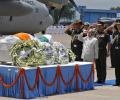
President Pranab Mukherjee pays an emotional tribute to APJ Abdul Kalam
